Biologist learns control theory
How many of these concepts are found in developmental molecular biology?
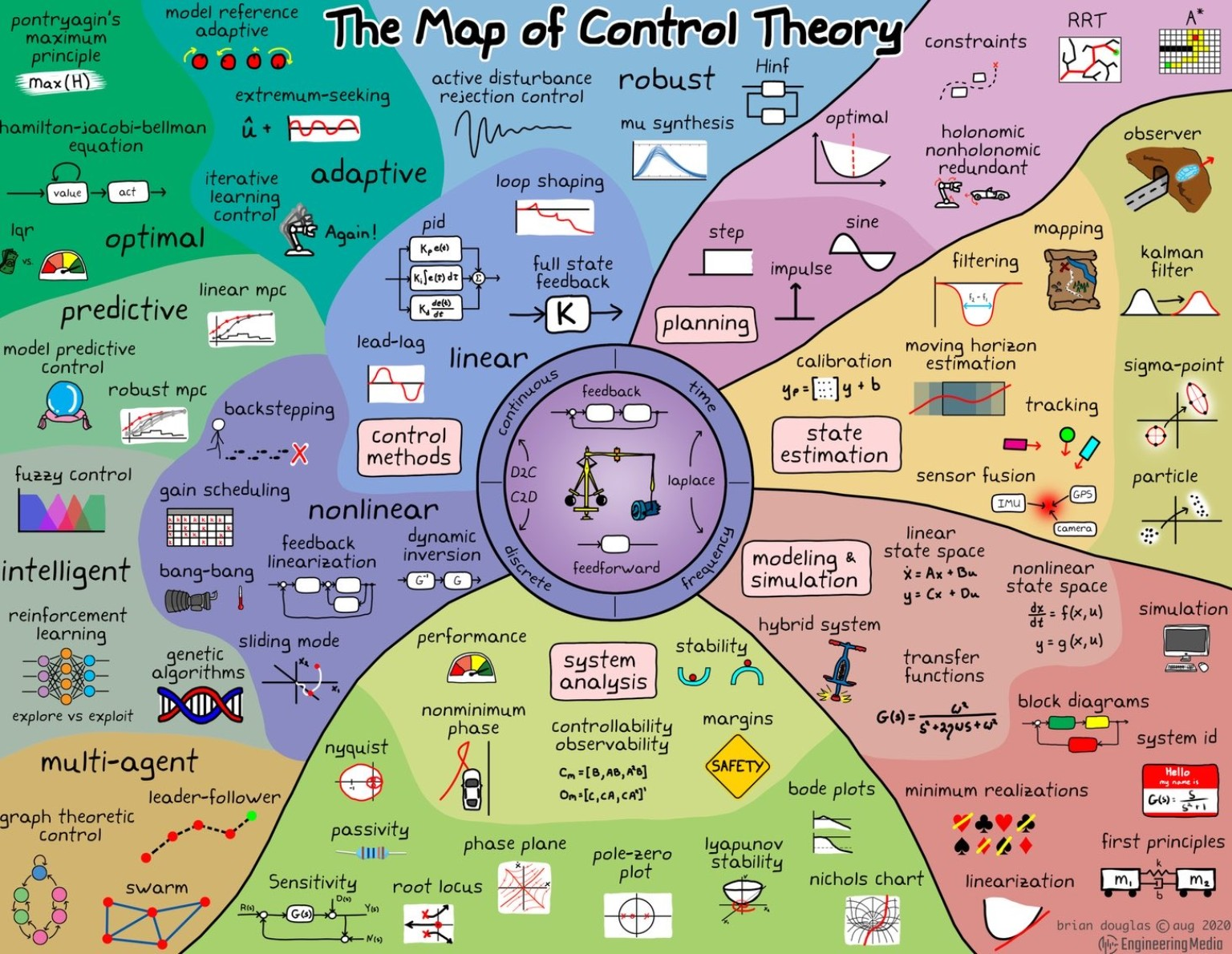
Quite a few. Let’s take a look at building blocks of control circuits and try to find their analogues in gene regulatory networks.
Boolean gates:
- AND
- Genes such and such
- OR
- Genes such and such
- …
Once you move above individual Boolean gates, digital systems become organized into reusable control motifs. These are not tied to a particular implementation (CMOS, FPGA, neurons, software) but describe recurring patterns for making decisions, sequencing actions, allocating resources, or maintaining state.
Here’s a rough hierarchy.
| Level | Module | Purpose |
|---|---|---|
| 0 | AND, OR, NOT, XOR | Primitive logic |
| 1 | Multiplexer, decoder, encoder | Route information |
| 2 | Latch, flip-flop, register | Remember information |
| 3 | Counter, comparator, ALU | Perform simple operations |
| 4 | Control modules | Coordinate behavior |
| 5 | CPUs, controllers, operating systems | Complex decision systems |
Some of the major control modules are:
Multiplexer (MUX)
“If condition X, choose signal A, otherwise choose signal B.”
Essentially implements selection.
if S: output = Aelse: output = B
Demultiplexer
Routes one incoming signal toward one of many outputs.
if S=0 -> Out0if S=1 -> Out1...
Arbiter
Decides which competing requester gains access.
CPUGPUDMA ↓Arbiter ↓Memory Bus
Examples
- bus arbitration
- mutexes
- thread scheduling
Priority Encoder
Chooses the highest-priority active request.
IRQ5IRQ4IRQ3↓IRQ5 wins
Comparator
Determines
- equal
- greater
- less
Used everywhere in branching.
Threshold Detector
Generalization of comparison.
if x > threshold: activate
Examples
- thermostats
- neuron firing
- quorum sensing
State Machine (FSM)
Stores internal state.
Idle ↓Running ↓Waiting ↓Finished
Every transition depends on
- current state
- inputs
rather than inputs alone.
Sequencer
Runs a predefined series of operations.
Step 1↓Step 2↓Step 3
Examples
- instruction execution
- washing machine
- PCR thermocycler
Timer
Produces events after elapsed time.
wait 5 ms↓fire signal
Counter
Keeps track of occurrences.
01234
Used for loops and timing.
Synchronizer
Coordinates asynchronous inputs.
Examples
- clock-domain crossing
- debouncing switches
- barrier synchronization
Handshake Controller
Coordinates two agents.
Producer ReadyConsumer Accept↓Transfer
Examples
- TCP acknowledgments
- AXI bus
- USB
Pipeline Controller
Determines when stages advance or stall.
FetchDecodeExecuteMemoryWriteback
Must detect hazards and stalls.
Hazard Detector
Looks for conflicts.
Instruction Awrites XInstruction Breads X↓stall
Scheduler
Chooses which task executes next.
Algorithms include
- round robin
- earliest deadline first
- shortest remaining time
- lottery scheduling
Dispatcher
Transfers execution to the selected task.
Often follows a scheduler.
Resource Allocator
Distributes limited resources.
Examples
- registers
- memory
- bandwidth
- laboratory instruments
Watchdog
Monitors another controller.
Normal heartbeat↓No heartbeat↓Reset
Supervisor
Higher-level monitor that can interrupt or override lower modules.
Examples
- operating system kernel
- aircraft flight supervisor
- industrial PLC supervisor
Feedback Controller
Continuously compares desired and actual state.
Desired speed↓Measure↓Error↓Correct
Examples
- cruise control
- thermostat
- PID controller
Rule Engine
Implements collections of conditional rules.
IF A and BTHEN CIF DTHEN E
Business software and expert systems often use these.
Planner
Chooses a sequence of actions toward a goal rather than reacting immediately.
Examples
- A* search
- STRIPS planners
- robot path planning
Policy Module
Maps states directly to actions.
state↓policy↓action
Reinforcement learning policies are examples.
Meta-controller
Selects among multiple controllers.
Normal controllerEmergency controllerCalibration controller↓Meta-controller chooses
Aircraft flight computers, autonomous vehicles, and modern CPUs all contain meta-control logic.
A useful taxonomy
These modules fall into a small number of abstract functions:
| Function | Representative modules |
|---|---|
| Selection | Multiplexer, arbiter, priority encoder, scheduler |
| Memory | Latch, register, FSM, counter |
| Sequencing | Sequencer, timer, pipeline controller |
| Comparison | Comparator, threshold detector, hazard detector |
| Coordination | Handshake controller, synchronizer, dispatcher |
| Allocation | Arbiter, resource allocator |
| Monitoring | Watchdog, supervisor |
| Regulation | Feedback controller, PID controller |
| Decision making | Rule engine, planner, policy module, meta-controller |
This way of organizing control modules is common across digital logic, operating systems, robotics, control theory, and even biological regulatory networks. For example, cell-cycle checkpoints act like supervisors and hazard detectors, transcription factors can implement threshold detectors and rule engines, and developmental gene regulatory networks often behave as finite state machines coupled to feedback controllers.