The Price Of Not Being Cancer
Jeanne Calment, who died in 1997 at the age of 122, holds the record for being the oldest human in history. This record remained uncontested for quite a while, with the runner-up, Kane Tanaka, reaching just 119 - full 3 years younger, an impressive and unexplained gap. If you treat maximum human lifespan as the main benchmark for life extension efforts, the natural suspicion would be that longevity science has been stagnant for the last 30 years.
Calment’s record will stand uncontested for the rest of 2020s - the oldest person alive right now, Ethel Caterham, is only 117 and won’t reach Calment’s age until 2032. If Caterham dies before that date, it seems plausible that Calment’s record could stand for the rest of 2030s.
What I do know for sure, though, is that in 2043 Calment will be overtaken by Henrietta Lacks, born in 1920 and surviving as an immortalized HeLa cell line in biology labs around the world. But what’s the upper limit on HeLa lifespan, if there is one?
[fill later in your own words: HeLa will match Calment’s 122 years in 2043; CTVT ~11k years between dogs; DFTD decades in Tasmanian devils; lab immortalization often only needs p53 / Rb / telomerase]
Is it always true that immortalized cells become parasitic? Are there no benign immortal cell lines in an organism?
If evolution doesn’t care enough to make bodies immortal, why did it bother to design body subunits to have easily accessible immortality that stays dormant?
Let’s try to find satisfying answers beyond just “cancer cells are just broken and shouldn’t be compared to healthy cells” and see if we can figure out what is it about cellular immortality that makes it hard to make these cells stick together.
A note on evolutionary language
If I was writing a paper instead of a blog post for popular consumption, I would separate the language for describing agentic actions (choices that a single agent, like an organism or a cell, makes) and the language for evolutionary design (“choices” that evolution “makes” by mindlessly churning through tons of agents). But since I trust people reading this to be comfortable using teleological language as a shorthand while keeping the real distinction in mind, I allow myself to use the same simple language for both processes.
Peto’s paradox
[fill later in your own words: each division risks a selfish clone; more cells × more time should mean catastrophic cancer risk; mice ~10^9 cells / 2y vs humans ~10^13 / 80y vs whales ~10^17 / ~90y — naive scaling says whales should be impossible]
They are not extinct. Rough lifetime cancer rates: mice ~40%, humans ~20%, elephants ~5% despite vastly more cells.
[fill later in your own words: elephants ~20 TP53 copies and hair-trigger apoptosis after DNA damage; bowhead whales show selection on DNA repair / cell-cycle genes — stronger control is possible, and it looks expensive]
Sorry — single cells
Let’s talk about what cancer cells actually do:
- Multiply blazingly fast
- Don’t die when told
- Hog resources
- Bully nearby cells
- Evolve to get better at all the above
Sorry, did I say “cancer cells”? My bad, “single cells”. It’s what living unicellular organisms do, and did ever since the Late Heavy Bombardment.
[fill later in your own words: multicellularity as a regulated truce over a Malthusian free-for-all; cancer as dismantling that truce and replaying the unicellular playbook]
[fill later in your own words: Godfrey-Smith de-Darwinization — cell fitness subordinated to organism fitness; principal–agent framing: organism must police trillions of agents mutating back toward ancestral competition]
Gerstung et al. (2020): 2,658 cancers; early drivers constrained, later progression more diverse drivers + genomic instability.
[fill later in your own words: serial atavism model (Lineweaver et al.) — speculative claim that cancers peel off recent multicellular controls first; mark as contested, not settled]
Layer 0: An ounce of prevention
[fill later in your own words: division as biological counterfeiting; proofreading + repair as quality control; “replication credit budget” — higher fidelity buys more total divisions before cancer odds blow up; extreme regenerators (planaria-class) need expensive high-fidelity stem-cell repair and still aren’t perfect]
Layer 1: Cellular class system
Quality control isn’t enough. You need a governance structure so somatic evolution does not become heritable.
Weismann barrier. Germline passes genes on. Somatic cells work, age, and die without genetic descendants. If any body cell could seed the next generation, mutations that favor cellular selfishness would spread.
Plants violate this: somatic embryogenesis, clones from leaves, heritable somatic mutation.
Single-cell bottleneck. Each generation starts from one fertilized egg and purges accumulated somatic junk. Plants bypass this too (runners, bulbs, grafts).
Allorecognition. Self vs non-self. Slime molds fuse with compatible genotypes; plants graft within families.
[fill later in your own words: asymmetric division as a way to make specialized daughters; Volvox Lag/RegA locks — workers vs reproducers; RegA SAND-domain repression of growth/reproduction in somatic cells; cost = specialized cells regenerate poorly]
The regeneration problem
[fill later in your own words: bodies as production systems, not random cell bags — small protected stem factories mint disposable workers]
Take your gut lining. Stem cells at the crypt base push daughters upward on a conveyor. Cells specialize on the way up, work a few days, die at the top. Skin and blood run the same architecture.
Workers rarely cause cancer because they are short-lived and non-dividing. Stem cells that do divide stay few, nested, and watched. Destroy the factory (chemo marrow, follicle stem cells) and replacement stops.
[fill later in your own words: differentiation / terminal differentiation; planaria ~20% body mass as stem cells = high regen, high cancer lottery; liver as rare reactivatable tissue (regen + cancer-prone); brain/heart nearly non-renewable in large animals; newborn-mouse heart regen window closes by ~day 7; size forces harsher non-renewable bets]
Layer 2: Governance architecture
[fill later in your own words: local two-key division (neighbor growth signals + internal checkpoints); contact inhibition via cadherins; cancer loses the handshake or ignores the stop]
Anchorage dependence. Many epithelia: stay attached or die (anoikis). Slows remodeling; blocks cells surviving in the wrong place.
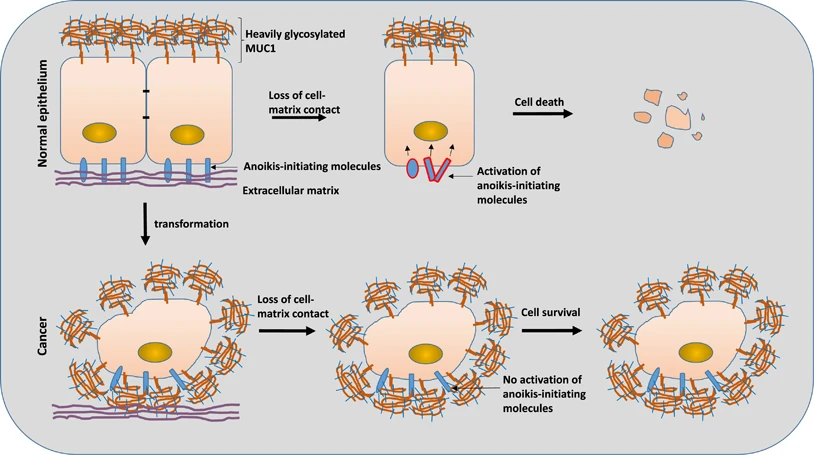
Source: https://www.nature.com/articles/cddis2017363
[fill later in your own words: stem cells leashed to niches (e.g. Wnt); leave niche, lose license; TGF-β-class regional cytostatics; morphogen zones + Hippo-YAP mechanical stop — perfect organs, poor regeneration]
Hormonal override
[fill later in your own words: glucocorticoids and GH/IGF-1 as system-wide vetoes on division; calorie restriction brakes growth globally; cancer goes deaf to systemic stop orders]
Layer 3: How to kill a cell
When governance fails: intrinsic suicide, assisted suicide, murder.
3A — Intrinsic
[fill later in your own words: p53 as three buttons — pause/repair, retire, die — via ATM/ATR damage sensors; cancers break p53 or overproduce its suppressors; trade-off = over-cautious killing of salvageable cells]
[fill later in your own words: telomeres as ~50-division punch cards; senescence when short; cancer counterfeits cards with telomerase]
[fill later in your own words: AMPK / ROS fair-weather division policies; cGAS-STING on cytosolic DNA; dsRNA antiviral tripwires (RIG-I/PKR) with false positives from retroelements; ribosome quality control → p53/inflammasome when factories stall]
3B — Assisted suicide
[fill later in your own words: FasL/TRAIL death-receptor handoff; collateral on wound-edge and activated lymphocytes]
[fill later in your own words: senescence as house arrest + SASP “call the cops”; useful acute, chronic cytokine swamp with age]
[fill later in your own words: TNF-class “die for the team” on bystanders; growth-factor addiction / tumors go autarkic; cell competition — fitter neighbors cull losers]
3C — Murder (immune)
[fill later in your own words: MHC-I peptidome ticker-tape for CTLs; tumors hide MHC-I; NK default-kill when the flagpole is missing; NKG2D stress ligands; macrophage CD47 don’t-eat-me vs eat-me; complement C3b/MAC; IDO1/ARG1 nutrient deserts that also starve CTLs; fibrotic encapsulation as last-ditch containment]
By middle age, mutant clones already occupy large fractions of esophagus and skin. Most are held. Time raises the odds one escapes.
Layer 4: When defenses escalate
[fill later in your own words: naive expectation = defenses decay post-reproduction; data = senescence fraction rises hard with age (e.g. liver ~1% at 25 → ~20% at 80), p53 activity up, immune activation up, stem cells actively throttled]
https://pubmed.ncbi.nlm.nih.gov/11909679/ [fill later in your own words: Weinstein reverse capacity / telomere framing — one paragraph in your voice]
If evolution stopped caring after reproduction, why keep running more expensive systems that damage tissue?
Hyperactive p53 mice (Tyner et al. 2002, p53^+/m): almost no cancer, aged faster, died earlier of organ failure. Median lifespan 96 vs 118 weeks; none died of cancer.
[fill later in your own words: late-life low-permissiveness regime — fewer divisions, stricter checkpoints, more senescence/apoptosis/immune scrutiny; police-state metaphor only if you can make it sound like you, not a thesaurus]
Hallmarks through the anti-cancer lens
[fill later in your own words: senescence — acute repair signal vs chronic SASP; stem-cell exhaustion as deliberate throttle not just wear; fibrosis as paving a rebellious district; inflammaging as threat-level-orange stuck on]
If that lens is right, aging is not only neglected maintenance. It is partly paid as the bill for keeping internal evolution caged.
Applications
Naive anti-aging moves can be pro-cancer:
- Clear senescent cells? You may be removing guards
- Boost regeneration? You may enable rebellion
- Extend telomeres? You may allow unlimited cheating
- Enhance growth pathways? You may feed tumors
Order matters: genomic stability first, then detection/elimination, only then dial back the paranoia.
Testable predictions
- “Cellular resilience / immortality / clock reset” marketing that ignores managed fragility should fail or backfire.
- Single-gene suppression without systemic trade-off accounting is suspect (exception: developmentally restricted oncogenes that should stay off in adults).
- Mid-life healthspan cosmetics can diverge from lifespan — demand lifespan data, not only frailty scores.
- Genome stability is a budget spent on regen, size, or longevity — not all three. Claims of free regen need mutation-rate and longevity receipts.
Why not just antagonistic pleiotropy or disposable soma?
[fill later in your own words: classic AP wants early benefit / late cost; telomere-shortening cancer protection is costly at 25 and 75 alike — “beneficial but costly” always, not a temporal flip]
[fill later in your own words: disposable soma predicts more resources → more maintenance → longer life; calorie restriction does the opposite of that prediction; resource scarcity is hostile to greedy tumor metabolism (mTOR down, AMPK up) — simpler than pure energy-allocation neglect]
Garcia-Cao “Super p53” (extra normal copies): more cancer resistance without the same premature-aging hit as hyperactive alleles — context matters; trade-off is real but not one-knob.
Appendix: Historical milestones
Chronology parked here so the main argument can move.
1961 — Hayflick: normal human cells ~50 doublings then senescence.
1970s — transplant immunosuppression → higher cancer; Burnet immune surveillance.
1975 — Mintz & Illmensee: teratocarcinoma cells in embryos normalize into chimeric tissues.
1975 — Morata & Ripoll: cell competition in flies.
1969 — Harris fusion: malignant × normal often non-tumorigenic → tumor suppressor concept.
Later — p53/TP53 as central suppressor, mutated in >50% human cancers.
Early 1990s — Greider et al.: telomere shortening as the Hayflick fuse; telomerase reverses it.
Theme across all of them: cancer is a coordination problem.