Types of explanations in biology
Much of classical philosophy of science I’ve read in my school years was built on the language of laws and reduction, following 20th century physics. As I entered biology, I found scientists working with an entirely different explanatory language.
- Mechanistic models
The “new mechanist” program in philosophy of science is basically the claim that a big fraction of successful explanations in life sciences looks less like a “law of nature”, and more like this:
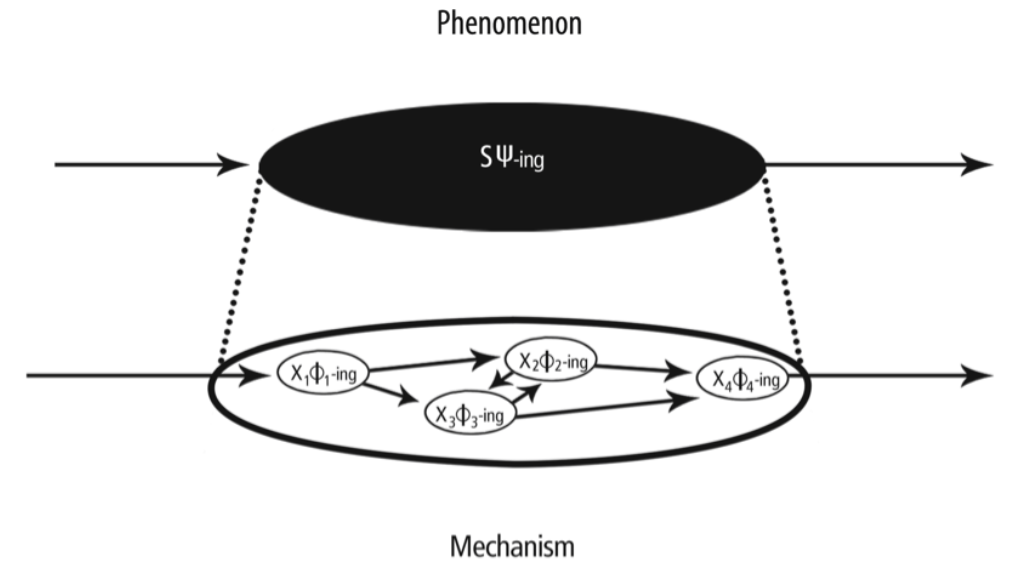
Explaining some phenomenon S mechanistically from beginning to end means treating this phenomenon as a black box that can be opened up to reveal
- material entities (x1, x2, x3…),
- activities/operations those entities do (ф1, ф2, ф3…),
- the chain of interactions between the entities (the causal arrows). You then show productive continuity: a chain of cause-and-effect relationships that links the beginning and end of the phenomenon without any “gaps” remaining. That’s it, explaining done.
Let’s look at this diagram showing how cells can rapidly adapt their gene expression to respond to cytokine signals.
![[Jak_Stat_-_cytokine_signalling[1]_waifu2x_art_noise1_scale.png]]
Here we have all the elements of a mechanistic model:
- Material entities: cell membrane, nuclear membrane, cytokines, cytokine receptor monomers, Janus kinase molecules (JAK), STAT protein monomers, DNA, tyrosine residues and phosphate residues.
- Activities: dimerization, phosphorylation, nuclear translocation, DNA binding, gene transcription.
- Causal chain: Cytokines as an input -> 1 -> 2 -> 3 -> 4 -> 5 -> gene expression response as an output
JAK-STAT pathway is probably the simplest pathway in cell signalling, so a diagram has plenty of space to spell out the chain of events explicitly. Most cell signaling diagrams assume you’re already familiar with the will compress this explanation
Look at this mechanistic diagram of cell senescence. It’s a list of molecules connected by interactions, that causally translate “stuff that causes cell senescence” (irradiation, chemotherapy, telomere shortening) into “observable effects of cell senescence” (cell cycle arrest, inflammation etc.).
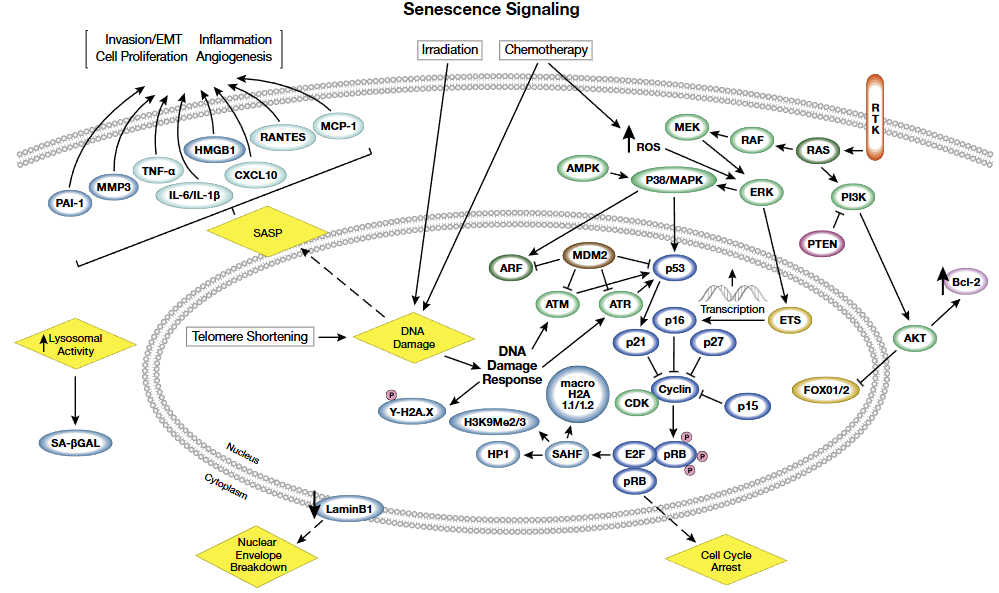
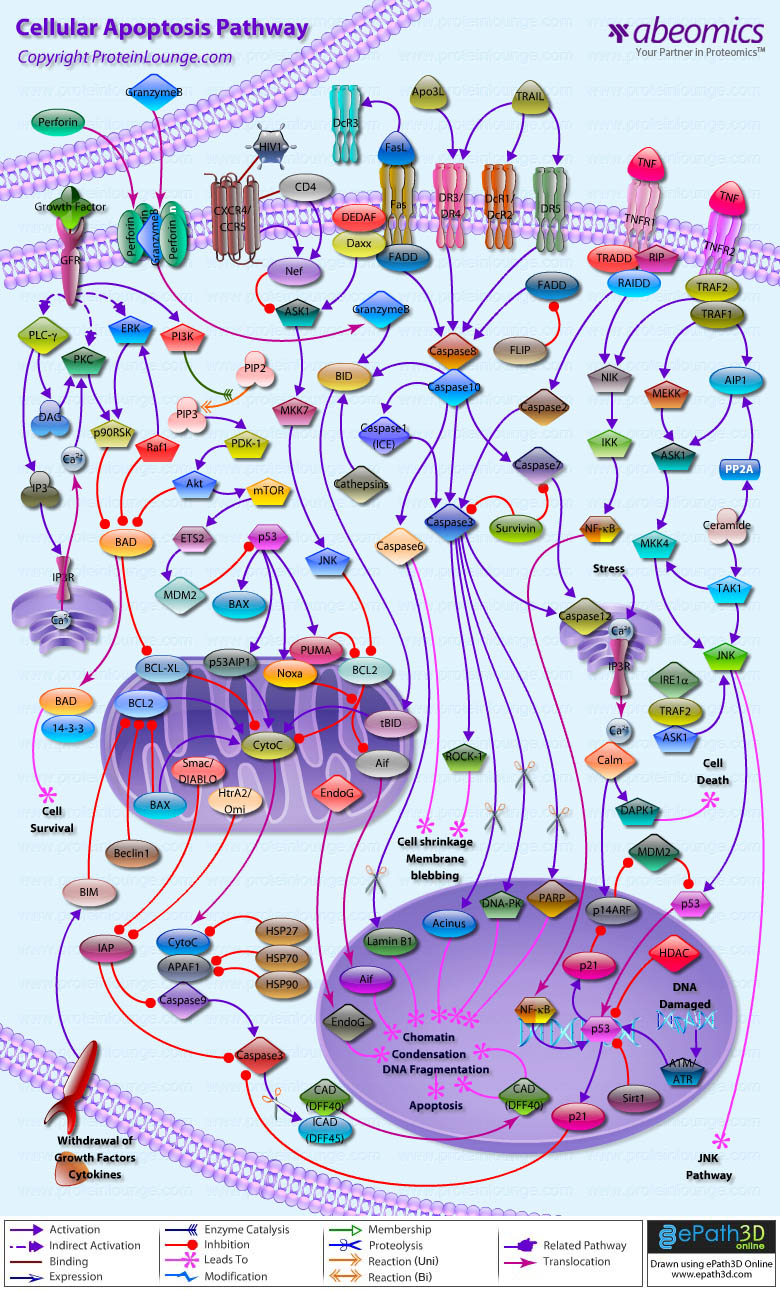
Note that the arrows are not just “correlations”
So: which areas of biology naturally “follow New Mechanism”? The ones where the central game is intervenable causal story + parts list + organisation diagram.
Molecular biology / biochemistry / enzymology. Core explanatory currency is literally mechanisms: binding, catalysis, conformational change, allostery, kinetics, structure–function, pathway wiring. If you can do mutagenesis, inhibition, reconstitution, and show necessity/sufficiency-ish claims, you are playing the mechanist game.
Cell biology (incl. trafficking, cytoskeleton, organelles, cell cycle). A lot of “what does X do?” cashes out as: which protein complexes, which physical interactions, which localisations, which state transitions. Intervention is king: knockdown/KO, rescue, perturbation, live-cell imaging.
Gene regulation / epigenetics / chromatin. Even when people get sloppy and say “X regulates Y”, the field’s gold standard is mechanistic: TF binding + cofactor recruitment + chromatin state change + polymerase dynamics + measurable expression change, ideally with perturbations (CRISPRi/a, degrons, locus editing).
Developmental biology (especially modern evo-devo adjacent mechanistic dev). Classic “gene regulatory networks”, morphogen interpretation, pattern formation mechanisms, cell fate attractors: heavily mechanist, even when it borrows dynamical-systems language. The explanation is still usually: components + interactions + spatial/temporal organisation.
Neuroscience at the circuit/cellular level; neurophysiology. Ion channels → excitability → synapses → circuits → behaviour. When it’s good, it’s mechanistic with interventions (optogenetics, lesions, pharmacology, targeted recordings). When it’s “just” fMRI correlations, it’s less mechanist (more on that below).
Immunology and host–pathogen biology. Receptor–ligand, signalling cascades, antigen presentation, effector mechanisms, immune evasion strategies: again, entities/activities/organisation with perturbation evidence.
Physiology and pathophysiology (at least in the causal story sense). Even though physiology sometimes uses control theory and phenomenological models, the culture still wants a mechanism: which tissues, what signals, what feedback loops, what constraints, what breaks in disease.
Microbial genetics / metabolic regulation / many parts of microbiology. Regulons, operons, metabolic control: strongly mechanistic when interventions are feasible.
A quick heuristic: if a subfield’s best papers are basically “here is the cartoon diagram of parts and arrows; here are the perturbations that force the arrows to be real; here is the reconstitution”, it’s the mechanist lens.
Let’s get back to the JAK-STAT diagram. Here are some biological questions the mechanism above doesn’t explain:
- Is the cell stuck in the “JAK-STAT on” state, or can it oscillate between being on and off?
- What did the ancestral versions of these molecules do, back before JAK-STAT pathway evolved?
- Dynamical-systems / control theory models
A lot of theoretical ecology, systems biology in its more mathematical form, some neuroscience, some developmental theory.
Here the “explanation” is not a parts list so much as a state-space landscape: feedback loops, attractors, bifurcations, stability, oscillations, robustness.
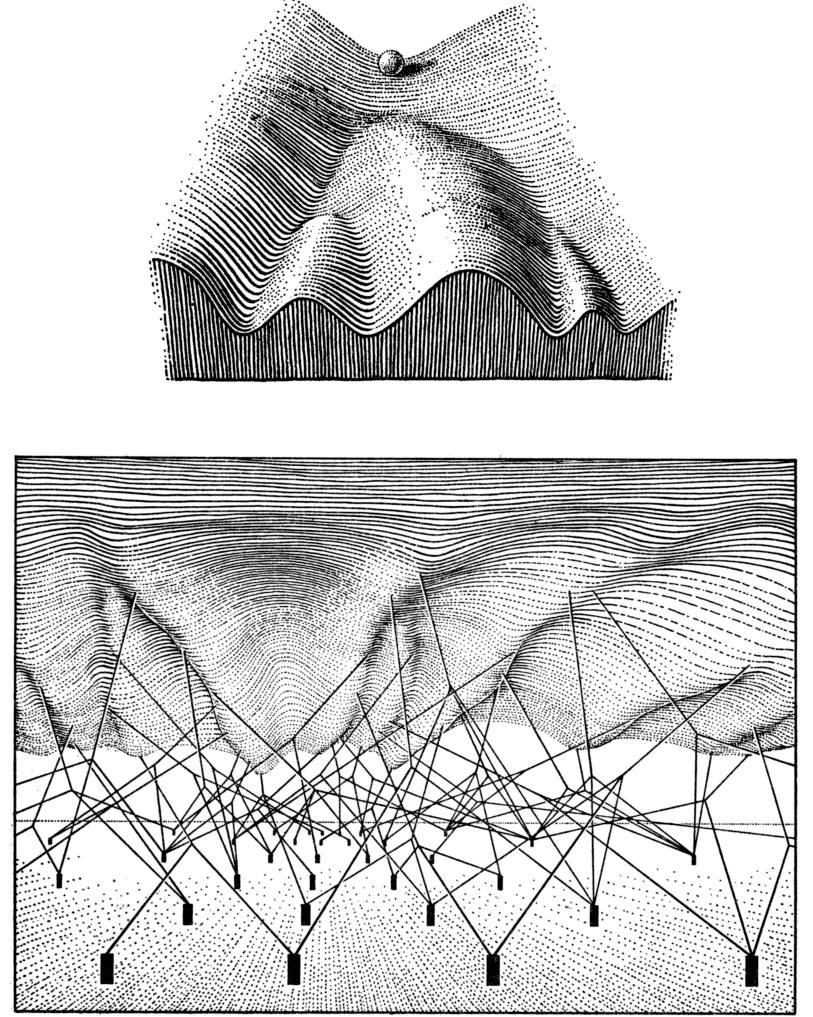
Typical outputs: differential equations, phase portraits, stability analyses, control laws, attractor structure. This is adjacent to New Mechanism but not identical: it can be mechanistic if states map cleanly to entities/activities; it becomes non-mechanistic when variables are abstract aggregates with no clean decomposition.
Alex M. Plum, Mattia Serra. Dynamical systems of fate and form in development, 2025
Statistical/associational models + causal inference mode Genetic epidemiology, GWAS, much of human complex trait biology, and a lot of ecology/field biology. The central objects are effects, associations, and identification strategies (instrumental variables, Mendelian randomization, natural experiments), not a parts-and-operations mechanism. You might later attach a mechanism, but the workhorse is: estimate an effect under assumptions.
Typical outputs: effect sizes, heritability partitions, risk models, causal graphs, confidence intervals. Why not just do mechanisms? Because the intervention you want (randomly assign genomes, environments, life histories) is impossible; and the mapping genotype→phenotype is massively polygenic and context-dependent.
- Historical reconstruction models Phylogenetics, comparative genomics, much of paleobiology, macroevolution, systematics. Explanations are often “how did this come to be?” not “what parts produce it now?” You infer ancestral states, branching histories, and sequence of events.
Typical outputs: trees, divergence times, ancestral reconstructions, narratives constrained by evidence. Why not just do mechanisms? You can do mechanisms of development, sure, but “why do birds have feathers?” is partly answered by history: contingencies, lineage constraints, exaptations.
- Population-thinking / selection-optimization explanations Population genetics, behavioural ecology, life-history theory, evolutionary game theory. Explanations here often look like: given variation + heritability + fitness differences + constraints, what traits/strategies are expected? Mechanisms matter, but often as constraints/implementations, not as the primary explanatory target.
Typical outputs: allele frequency dynamics, ESS conditions, selection gradients, adaptive landscapes (carefully interpreted). Why not just do mechanisms? Because the explanatory punchline is often about why this design is favoured across many possible implementations.
- Phenomenological / predictive models (“shut up and fit the curve”) A lot of omics-driven biology, biomarker work, some fMRI/EEG decoding, many “signatures”, and increasingly ML biology. Goal is prediction and compression: map inputs to outputs reliably, even if the internal representation is not interpretable as a mechanism.
Typical outputs: classifiers, embeddings, signatures, predictive accuracy. Why not just do mechanisms? Sometimes because the system is too complex and you need a useful predictor now; sometimes because the field hasn’t earned causal identification yet.
Important caveat: most subfields are mixed People often argue past each other because they treat their mode as “real explanation” and the other mode as “mere description”.
Example: in ageing biology, you constantly see clashes between:
- mechanistic explanations of aging (senescence pathways, DNA damage repair, mTOR signalling, proteostasis, etc.),
- population/evolutionary explanations of aging (antagonistic pleiotropy, mutation accumulation, life-history trade-offs),
- dynamical-systems explanations of aging (tipping points, resilience loss, attractor drift),
- and predictive biomarker explanations of aging (clocks, frailty indices).
All are partly legitimate, but they close different gaps in our understanding.