The types of tumor suppressor genes most commonly distinguished in cancer biology are gatekeeper, caretaker, and landscaper genes. They differ by the control that is lost when a gene is inactivated: direct growth restraint, genome maintenance, or regulation of the surrounding tissue.
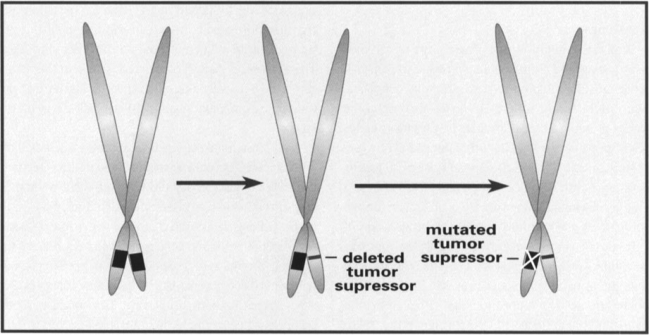
A common tumor-suppressor failure mode: one copy is deleted and the remaining copy is mutated, ending the cell’s supply of the inhibitory gene product. From Deininger, 1999.
Classification
Tumor suppressor genes are grouped by the control that is lost when the gene is inactivated:
Gatekeepers: restrain the potentially malignant cell itself by limiting division, enforcing cell-cycle arrest, or promoting apoptosis.
Caretakers: maintain genome stability and lower the rate at which later driver mutations appear.
Landscapers: regulate the tissue environment around the potentially malignant cell.
Kinzler and Vogelstein introduced the gatekeeper/caretaker distinction in the late 1990s, and later reviews treat landscapers as a third functional class.12
A cell carries two alleles of each tumor suppressor. A mutation that inactivates one allele leaves the second allele producing functional protein, so the suppressor’s growth-restraining activity survives the first hit. In the classic two-hit pattern the cell loses that activity only when a second event inactivates the remaining allele.3
Gatekeeper genes
Gatekeeper genes restrain the expansion of abnormal cells. When both alleles are inactivated, the cell loses a brake on proliferation. The failure is cell-autonomous: the abnormal clone persists longer and acquires later changes.
Common gatekeeper examples include:
APC: an initiation gatekeeper in colorectal epithelium; APC loss can allow colon crypt cells to form adenomas.
RB1: gates the G1/S transition by controlling E2F-dependent cell-cycle entry.
p53: a broader progression gatekeeper; DNA damage, oncogene stress, and other signals can feed into p53-mediated arrest, senescence, or apoptosis.
Gatekeeper loss is rate-limiting in a tissue that already contains dividing cells, because the lost gatekeeper had been the one deciding which of those cells may keep dividing.4
Caretaker genes
Caretaker genes maintain the genome from which later cancer mutations are drawn. Their loss lets later mutations accumulate, so a subsequent mutation, deletion, rearrangement, or replication error can reach a gatekeeper, an oncogene, or another cancer-relevant system.
Common caretaker examples include:
DNA mismatch repair genes: defective mismatch repair lets replication errors persist, producing microsatellite instability and a higher mutation supply.
BRCA1 and BRCA2: homologous recombination repair helps maintain chromosome integrity.
ATM and ATR: DNA damage response kinases that help coordinate checkpoint and repair programs after damage.
A defective caretaker supplies a clone with a larger mutation pool, so later driver mutations surface more often and a gatekeeper or oncogene hit grants the growth advantage more easily. Caretaker loss touches more tissue types, since each renewing tissue depends on replication fidelity and repair.43
Landscaper genes
Landscaper genes regulate the tissue environment around epithelial cells. A mutated landscaper makes the local microenvironment friendlier to neoplastic growth. Reviews describe this class as genes whose loss changes extracellular matrix proteins, cell-surface markers, adhesion molecules, growth factors, and neighboring stromal cells.2
Epithelial cells grow in a structured neighborhood of basement membrane, stromal cells, immune cells, mechanical constraints, soluble signals, and adhesion cues. When the neighborhood changes, a clone picks up survival, growth, or invasion support from its surroundings.
Landscaper loss acts through the tissue before it acts through the epithelial clone:
A gene that normally maintains stromal or extracellular-matrix conditions is inactivated.
The local tissue environment changes.
Epithelial cells that would otherwise be restrained receive more survival, growth, or invasion support.
A cell found in a cancer may be important in three ways:
It changes the cell itself.
It changes how the cell communicates with the stroma.
It reflects a changed tissue environment.
Boundary cases
p53 spans two classes. As a gatekeeper it stops damaged or stressed cells from expanding. It also shows caretaker-like effects, because p53 signaling shapes DNA damage responses and genomic stability.4 NF1 sits in the gatekeeper and landscaper classes in some contexts.2
A gene can contribute through one or several mechanisms: enforcing a cell-cycle checkpoint, repairing DNA damage, maintaining cell adhesion, or transmitting signals that reshape the local tissue. The class follows the cancer-preventing function lost in a given tissue and stage.
Consequences
Each class makes a different first prediction:
Class
First prediction
Measurement
Gatekeeper
clonal expansion
proliferation, arrest
Caretaker
higher supply of later mutations
mutation burden, repair defects
Landscaper
changed tissue context
stromal or extracellular-matrix changes
The tumor suppressor theory of aging uses the same split. A gatekeeper-heavy tissue may suppress cancer by arresting or killing damaged cells. The same response depletes proliferative capacity or accumulates senescent cells. A caretaker-heavy tissue may postpone cancer by keeping the mutation supply low. A tissue whose landscape shifts with age may grow permissive before a clone has acquired every cell-autonomous advantage.
OCR excerpt: “Gatekeepers serve to prevent cancer by directly inhibiting the growth of dysplastic cells through arrested mitosis or apoptosis.” (doc:valerieharris2017/page:5/block:6)
Review excerpt (Deininger, 1999)
Deininger, 1999 — passage defining caretaker genes and their mutation-suppressing role.
HTML excerpt: “Caretaker genes are genes responsible for keeping other genes healthy (i.e. suppressing mutation).” (https://pmc.ncbi.nlm.nih.gov/articles/PMC3145442/, Caretaker Genes section)
Review excerpt (Rajabi et al., 2022)
Rajabi et al., 2022 — passage defining landscaper tumor suppressor genes and their microenvironmental mechanism.
HTML excerpt: “When mutated, these genes contribute to tumor growth by creating a favorable microenvironment for uncontrolled cell proliferation… the mechanisms of action of landscaper genes involve the direct or indirect regulation of extracellular matrix proteins, cell-surface markers, adhesion molecules, and growth factors.” (https://pmc.ncbi.nlm.nih.gov/articles/PMC9139614/, section 2.3)
Footnotes
Kinzler KW, Vogelstein B. Cancer-susceptibility genes. Gatekeepers and caretakers. Nature. 1997;386(6627):761-763. doi:10.1038/386761a0. PubMed. ↩
Rajabi S, Alix-Panabières C, Sharbatdar Alaei A, et al. Looking at Thyroid Cancer from the Tumor-Suppressor Genes Point of View. Cancers. 2022;14(10):2461. doi:10.3390/cancers14102461. PMC. ↩↩2↩3
Deininger P. Genetic Instability in Cancer: Caretaker and Gatekeeper Genes. Ochsner Journal. 1999;1(4):206-209. PMC. ↩↩2
Harris VK, Schiffman JD, Boddy AM. Evolution of Cancer Defense Mechanisms Across Species. 2017. ↩↩2↩3
Continue to read the draft.
Log in and become a supporter to read the full article.