Indeterminate growth is a life-history pattern in which an organism continues to increase in size even after reaching adulthood, instead of reaching a fixed adult size. The opposite extreme, a fixed-cell-count in adulthood, is eutely.
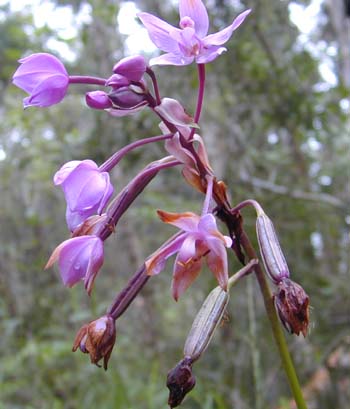
Spathoglottis plicata (Philippine ground orchid) with an indeterminate raceme: fruits mature below while new flowers continue to form toward the growing tip. Photo by Eric Guinther, Wikimedia Commons, CC BY-SA 3.0.
Definition and variation
The growth classification applies at more than one biological scale. A flowering shoot can be indeterminate even though the plant bearing it eventually dies. In life-history biology, the unit being classified is the whole organism and the reference point is reproductive maturity.
Determinate growth has an endpoint in the organism’s normal developmental programme. This does not mean that every cell stops dividing: an adult bird or mammal can still replace skin, blood, and gut cells after body growth has largely stopped. Indeterminate growth concerns the trajectory of body size. Growth is rapid before maturity and continues more slowly afterwards in many molluscs, crustaceans, fish, amphibians, and reptiles.1
Indeterminate growth need not continue at a constant rate or reach an immense size. Growth may become extremely slow, and death can end a trajectory that has no fixed developmental endpoint. The pattern occurs across plants, insects, fish, reptiles, and corals.2
Growth form is therefore a graded trait. An organism that matures near its maximum size has little scope for adult growth; one that matures while still small has much more. Size at maturity divided by maximum size captures that difference better than forcing every species into one of two boxes.3
Growth and reproduction
After maturity, acquired energy can support maintenance, immediate reproduction, or further growth. Their proportions vary with species and conditions. Growth becomes an investment in later reproduction only when a larger body can produce or provision more offspring. In a size-dependent life-history model, reducing present reproduction can then increase future reproductive output by increasing body size.4
That sequence contains two separate links: survival allows another period of growth, and added size raises later fecundity. If either link is weak, indeterminate growth gives little evolutionary reward for reaching an older age. If both are strong, a large old individual can contribute more offspring per breeding event than a newly mature one. Williams used this size-fecundity relation to predict slower senescence in organisms that continue growing after maturity.1
The relevant quantity is reproductive value: an individual’s expected contribution to future generations from its present age and state. In the usual selection-shadow account, fewer individuals survive to old ages, so selection is less effective against harmful late-life traits. Size-dependent fecundity pushes in the other direction. When fecundity rises disproportionately with size and age, older size classes make a larger contribution to future generations, strengthening selection on traits expressed in those classes.5
The model describes how growth changes the fitness return on survival and maintenance. It does not specify a mechanism that repairs age damage. Growth is only one way to shift a population’s reproductive value toward later ages.5
Consequences for ageing
Senescence has at least two population-level measurements. Actuarial senescence is an increase in mortality risk with age after maturity. Reproductive senescence is a decline in reproductive performance with age.6 The two trajectories can be uncoupled: fertility can change without a matching change in mortality, and mortality can change without a matching change in fertility.7
Comparative life tables provide a partial test of the growth-fecundity prediction. Among the indeterminate growers classified in one broad dataset, mortality was approximately constant or decreased somewhat with age, while fertility was approximately constant or increased somewhat.8 A later review reported little evidence of rising mortality in 98% of the plant species and all of the corals in its displayed data, and a declining mortality risk in the indeterminately growing South American river turtle (Podocnemis expansa).3
These observations fit the prediction that adult growth can preserve the reproductive value of later life. They do not establish growth form as the sole cause. Some indeterminate growers show ordinary positive senescence,3 and reproductive decline need not follow the same trajectory as mortality.7
Limits
An indeterminate grower may add less length in each successive year while never reaching a programmed adult endpoint. It remains vulnerable to disease, injury, predation, and physiological deterioration. Continued growth and continued survival are separate traits.
Negative actuarial senescence means that measured mortality risk falls with age. It does not mean that individual cells or organs become younger. A tree’s mortality curve can decline as the tree grows larger, but the curve combines physiological state with cohort composition, competition, predation, and local conditions.9
Growth, actuarial senescence, reproductive senescence, and physiological deterioration must therefore be measured separately. Indeterminate growth supplies one route by which later survival can retain evolutionary value. It neither guarantees increasing fertility nor identifies the cellular mechanisms that maintain a particular organism.
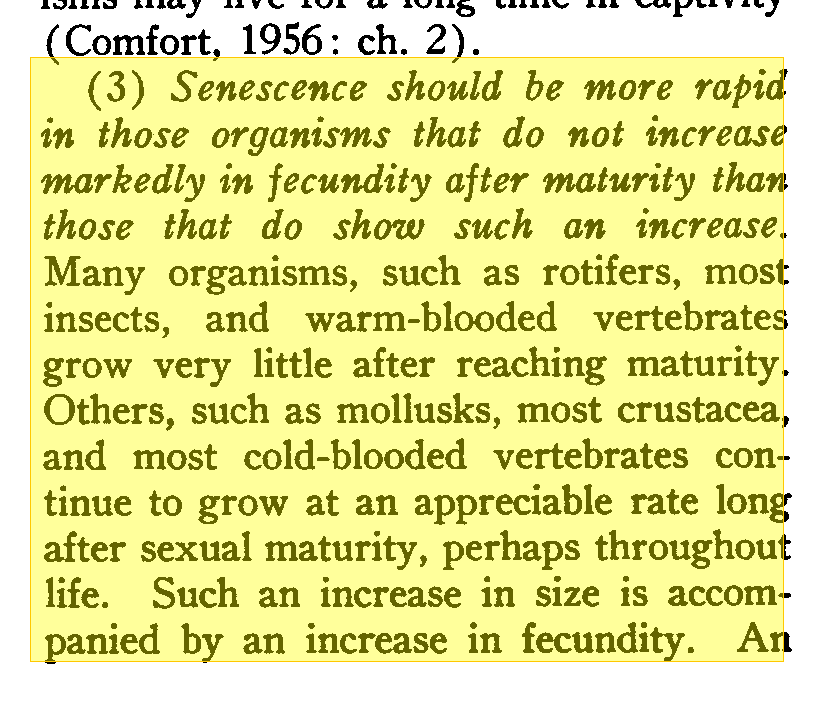
Williams, 1957 — passage contrasting post-maturity growth patterns and linking added size to increased fecundity.
OCR excerpt: “Many organisms, such as rotifers, most insects, and warm-blooded vertebrates grow very little after reaching maturity. Others, such as mollusks, most crustacea, and most cold-blooded vertebrates continue to grow at an appreciable rate long after sexual maturity, perhaps throughout life. Such an increase in size is accompanied by an increase in fecundity.” (p. 8, doc:georgec.williams1957/page:8/block:5)
Review excerpt (Roper et al., 2021 — taxonomic range)
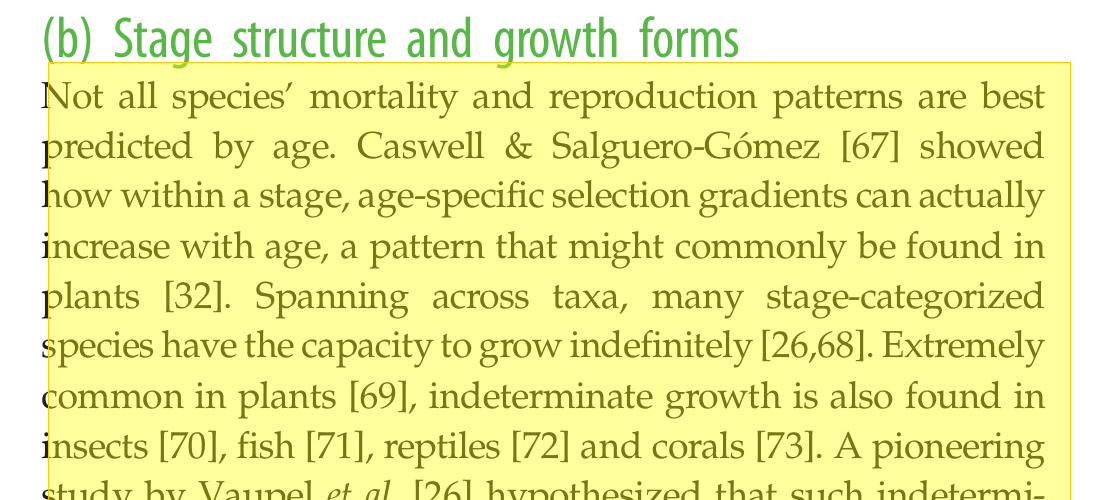
Roper et al., 2021 — passage locating indeterminate growth across plants, insects, fish, reptiles, and corals.
OCR excerpt: “Spanning across taxa, many stage-categorized species have the capacity to grow indefinitely. Extremely common in plants, indeterminate growth is also found in insects, fish, reptiles and corals.” (p. 6, doc:markroper2021/page:6/block:4)
Review excerpt (Roper et al., 2021 — size-dependent model)
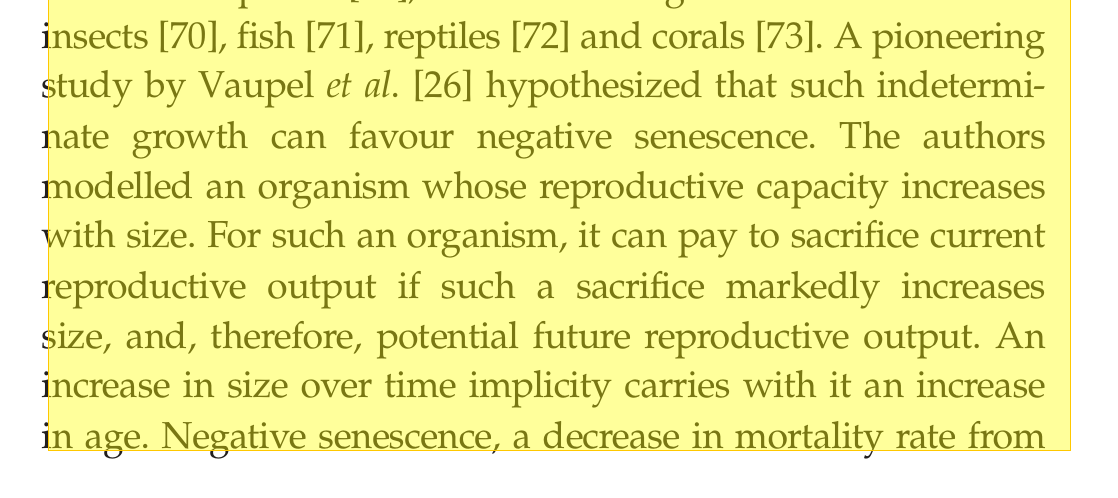
Roper et al., 2021 — passage summarizing a model in which growth can trade present reproduction for greater future reproductive output.
OCR excerpt: “The authors modelled an organism whose reproductive capacity increases with size. For such an organism, it can pay to sacrifice current reproductive output if such a sacrifice markedly increases size, and, therefore, potential future reproductive output.” (p. 6, doc:markroper2021/page:6/block:4)
Review excerpt (Roper et al., 2021 — reproductive value)
Roper et al., 2021 — passage explaining how increasing fecundity with size shifts reproductive value toward older size classes.
OCR excerpt: “If reproduction is much lower at younger, mature ages (lower sizes) and increases disproportionately with size and age, then the relative reproductive value of older ages classes and the abundance of mothers will be biased towards older age classes. Growth and increasing reproductive capacity with age provide just one mechanism to alter a population’s reproductive value and stable age distributions in favour of delaying senescence.” (p. 6, doc:markroper2021/page:6/block:7)
Comparative study excerpt (Jones et al., 2014)
Jones et al., 2014 — reported mortality and fertility trajectories among indeterminate growers in the comparative dataset.
OCR excerpt: “[In] these indeterminate growers, mortality is approximately constant or decreases somewhat with age, whereas fertility is more or less constant or increases to some extent. Species with indeterminate growth may exhibit patterns of senescence that are fundamentally different from those of species with determinant growth.” (p. 6, doc:jones2014/page:6/block:0)
Review dataset and limitation excerpt (Roper et al., 2021)
Roper et al., 2021 — dataset summary, an indeterminate-grower exception, and the proposal to treat growth form continuously.
OCR excerpt: “In our display of currently available demographic data, 98% of studied plant species and all of our studied corals show little evidence of an increase in risk of mortality with age… Some indeterminately growing species do still display senescence… Transforming growth form into a continuous variable, for example, as size at maturity as a proportion of maximum size, will allow for more quantitative comparative tests on the effects of growth form on senescence.” (p. 6, doc:markroper2021/page:6/block:6)
Conceptual analysis excerpt (Cohen et al., 2020)
Cohen et al., 2020 — passage distinguishing a falling demographic mortality curve from reversal of organismal deterioration.
OCR excerpt: “A species such as a tree that shows dramatic declines in mortality as it grows larger is not showing negative senescence in any way that would be of interest in terms of understanding sub-organismal processes related to deterioration with age, or their evolution. The demographic patterns reflect an amalgam of underlying processes - physiological, social, cohort effects, competition/predation, population-specific effects, etc.” (p. 12, doc:cohen2020a/page:12/block:2)
Review definition excerpt (Roper et al., 2021)
Roper et al., 2021 — definition of senescence through age-related mortality and reproductive decline after maturity.
OCR excerpt: “Senescence, the increasing risk of mortality and decline in reproduction with age after maturity, has long been explained by a collation of theories defining the ‘classical evolutionary framework of senescence’.” (p. 1, doc:markroper2021/page:1/block:17)
Review comparison excerpt (Roper et al., 2021)
Roper et al., 2021 — passage reporting that reproductive and actuarial senescence can follow different age trajectories.
OCR excerpt: “Our results here show that age trajectories of reproduction are often uncoupled from the pattern of actuarial senescence… both uncoupling and concurrent patterns of actuarial and reproductive senescence appear common.” (p. 6, doc:markroper2021/page:6/block:1)
Roper M, Capdevila P, Salguero-Gómez R. “Senescence: why and where selection gradients might not decline with age.” Proceedings of the Royal Society B. 2021;288:20210851. doi:10.1098/rspb.2021.0851. ↩
Roper M, Capdevila P, Salguero-Gómez R. “Senescence: why and where selection gradients might not decline with age.” Proceedings of the Royal Society B. 2021;288:20210851. doi:10.1098/rspb.2021.0851. ↩↩2↩3
Roper M, Capdevila P, Salguero-Gómez R. “Senescence: why and where selection gradients might not decline with age.” Proceedings of the Royal Society B. 2021;288:20210851. doi:10.1098/rspb.2021.0851. ↩
Roper M, Capdevila P, Salguero-Gómez R. “Senescence: why and where selection gradients might not decline with age.” Proceedings of the Royal Society B. 2021;288:20210851. doi:10.1098/rspb.2021.0851. ↩↩2
Roper M, Capdevila P, Salguero-Gómez R. “Senescence: why and where selection gradients might not decline with age.” Proceedings of the Royal Society B. 2021;288:20210851. doi:10.1098/rspb.2021.0851. ↩
Roper M, Capdevila P, Salguero-Gómez R. “Senescence: why and where selection gradients might not decline with age.” Proceedings of the Royal Society B. 2021;288:20210851. doi:10.1098/rspb.2021.0851. ↩↩2
Jones OR, et al. “Diversity of ageing across the tree of life.” Nature. 2014;505:169-173. doi:10.1038/nature12789. ↩
Cohen AA, Legault V, Fülöp T. “What if there’s no such thing as ‘aging’?” Mechanisms of Ageing and Development. 2020;192:111344. doi:10.1016/j.mad.2020.111344. ↩
Continue to read the draft.
Log in and become a supporter to read the full article.