The Weismann barrier is the strict distinction between the “immortal” germ cell lineages producing gametes and “disposable” somatic cells in animals, in contrast to Charles Darwin’s proposed pangenesis mechanism for inheritance.1
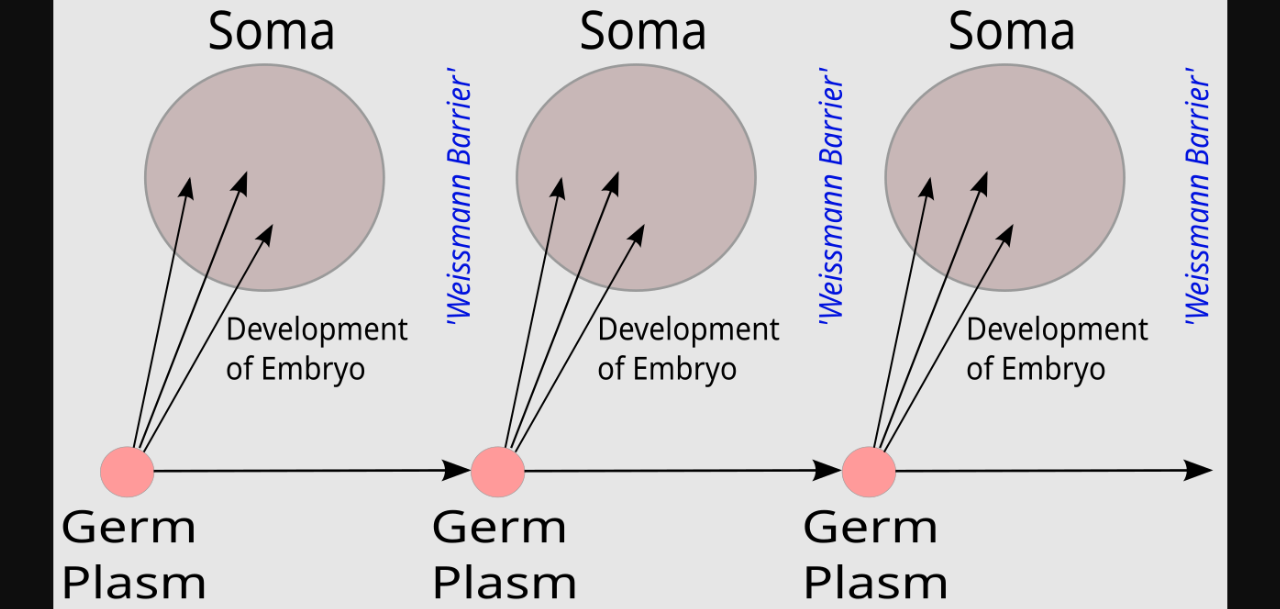
Diagram of Weismann’s germ-plasm theory: the hereditary material, the germ plasm, is confined to the gonads. Somatic cells (of the body) develop afresh in each generation from the germ plasm. Whatever may happen to those cells does not affect the next generation. Wikimedia Commons.
In more precise terminology, hereditary information is copied only from germline cells to somatic cells. New information from somatic mutation is not passed on to the germline; the barrier concept implies that somatic mutations are not inherited.2
Weismann set out the concept in 1892.1 The use of the theory, commonly in the context of the germ plasm theory of the late 19th century, is sometimes referred to as Weismannism.3 Some authors distinguish Weismannist development, in which there is a distinct germline, from somatic embryogenesis.4
The Weismann barrier was of great importance in its day. Among other influences it effectively banished certain Lamarckian concepts: in particular, it would make Lamarckian inheritance from changes to the body (the soma) difficult or impossible.3 It remains important, but has required qualification in the light of modern understanding of horizontal gene transfer and other genetic and histological developments.5
Formally: “the developmental strategy must allow germ-role cells to give rise to soma-role cells … and must forbid soma-role cells to give rise to germ-role cells”.6
Exceptions
Basal animals
Basal animals such as sponges (Porifera) and corals (Anthozoa) contain multipotent stem cell lineages that give rise to both somatic and reproductive cells. The Weismann barrier appears to be of a more recent evolutionary origin among animals.7
Plants
In plants, genetic changes in somatic lines can and do result in genetic changes in the germ lines, because the germ cells are produced by somatic cell lineages (vegetative meristems), which may be old enough (many years) to have accumulated multiple mutations since seed germination, some of them subject to natural selection.8 Adult, reproducing plants tend to produce many more offspring in number than animal organisms.
The barrier is therefore a matter of timing as much as kind. A mutation reaches the next generation only if it strikes before a host sequesters its germ line, arises in a germ line or meristem, or invades a lineage that does not sequester one at all.9
Evolution of the barrier
Irreversible somatic differentiation is favored when three conditions hold: cell differentiation is costly; a small number of vegetative cells significantly improve the organism’s performance; and the organism is large enough.10 Under those conditions, closing the input — preventing the soma’s mutations from re-entering the germline — keeps those mutations from reaching the next generation.11
History
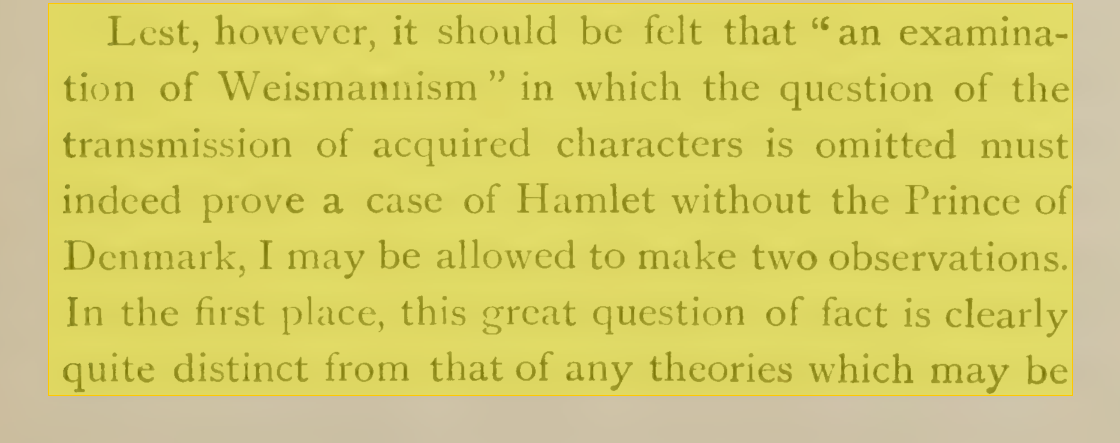
The doctrine was named and first systematically examined by George John Romanes in 1893 (An Examination of Weismannism), who recorded that the continuity-of-germ-plasm view had been present to Darwin’s mind as a logically possible alternative to pangenesis, and that Francis Galton, Darwin’s cousin, had answered the question of acquired characters in the same manner as Weismann would a decade later.3 Romanes’s book also reported the principal contemporary challenge: grafting experiments that appeared to show the somatic tissues of one organism, grafted onto another, affecting the host’s germinal elements so that its offspring resembled the donor. Romanes noted that this line of evidence had been “disregarded both by Weismann and his followers”.12
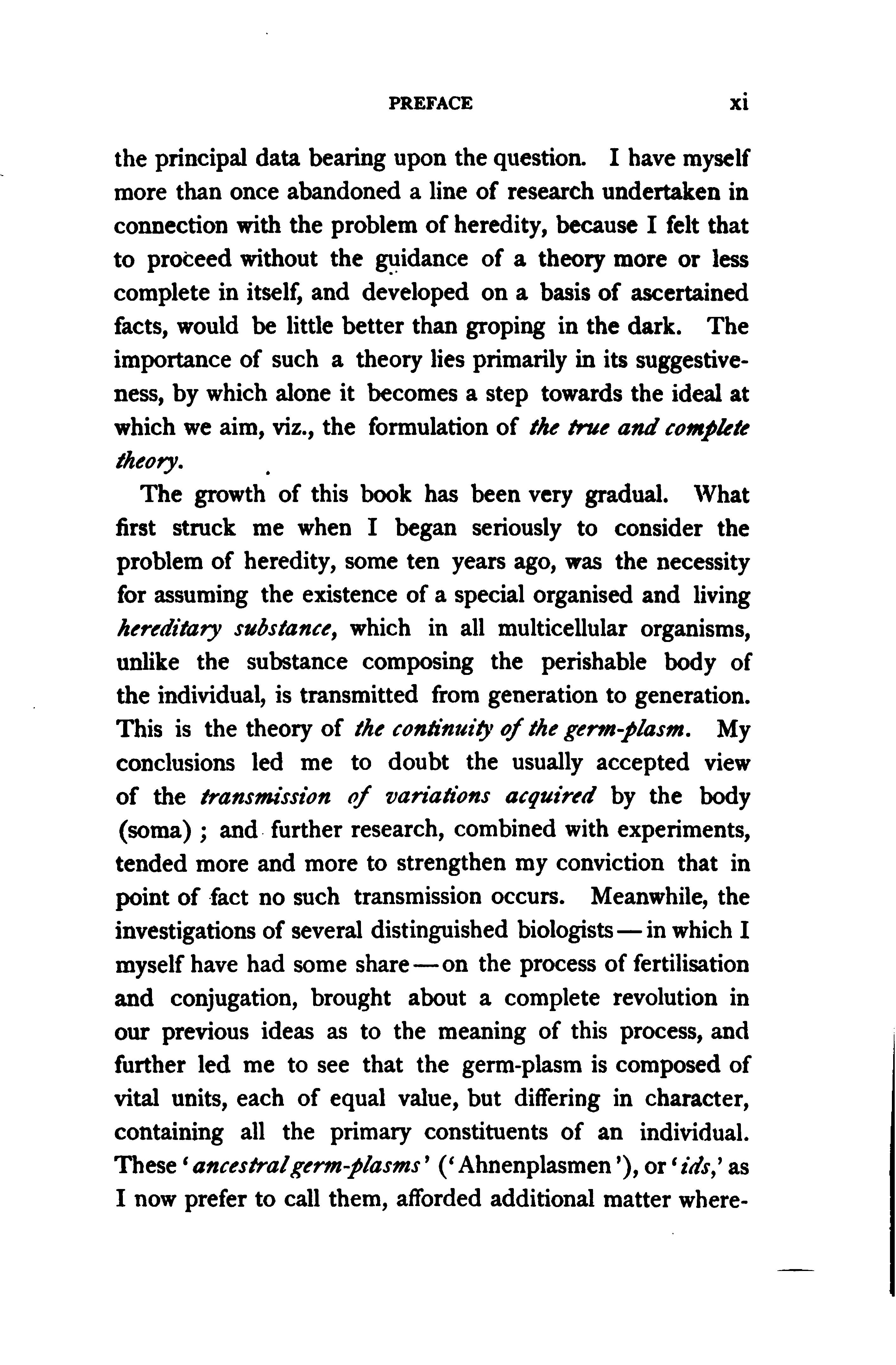
Weismann, 1893 — preface distinguishing the hereditary substance from the perishable body.
OCR excerpt: “a special organised and living hereditary substance, which in all multicellular organisms, unlike the substance composing the perishable body of the individual, is transmitted from generation to generation. This is the theory of the continuity of the germ-plasm.” (preface, p. xi)
Romanes, 1893 — the ‘continuity of germ-plasm’ as an alternative to Darwin’s pangenesis; Galton answered the acquired characters question first.
OCR excerpt: “the idea of what is now called a ‘continuity of germ-plasm’ was present to Darwin’s mind as a logically possible alternative to the one which he adopted in his theory of pangenesis … Galton’s ‘Theory of Heredity’ presented … the question of the transmission of acquired characters, and answered it in almost exactly the same manner as Weismann did about ten years later.” (doc:romanes1893/page:17/block:2)
Primary source excerpt (Gao et al., 2021 — strict rule)
Gao et al. 2021 — germ-role giving rise to soma-role, soma-role forbidden from giving rise to germ-role.
OCR excerpt: “the developmental strategy must allow germ-role cells to give rise to soma-role cells … and must forbid soma-role cells to give rise to germ-role cells.” (doc:gao2021/page:3/block:3)
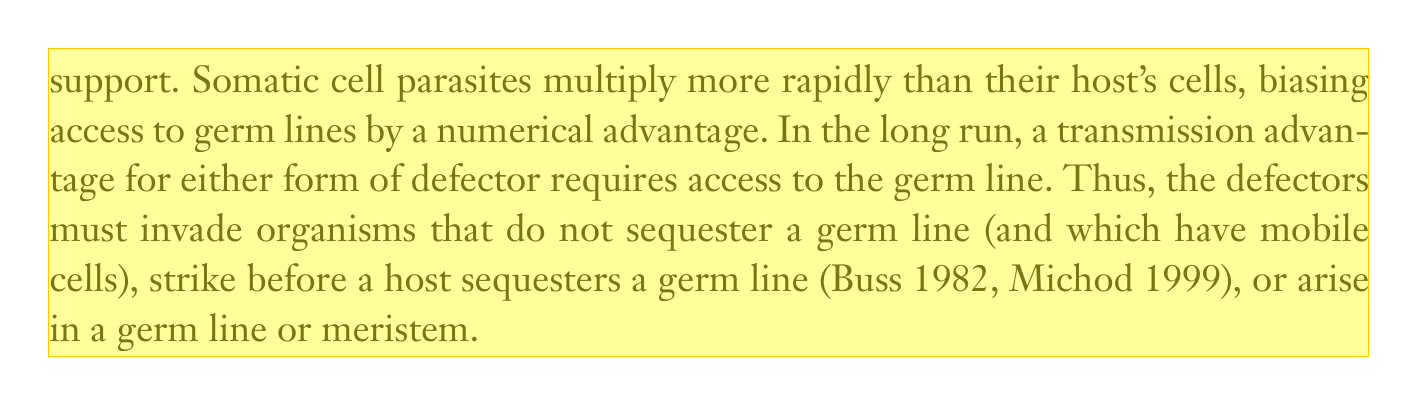
Grosberg & Strathmann 2007 — how a defector can still reach a germ line.
OCR excerpt: “the defectors must invade organisms that do not sequester a germ line (and which have mobile cells), strike before a host sequesters a germ line, or arise in a germ line or meristem.” (doc:richardk.grosberg2007/page:12/block:0)
Primary source excerpt (Gao et al., 2021 — the three components)
Gao et al. 2021 — the three components: costly differentiation, performance of the soma, and large size.
OCR excerpt: “three components are necessary for the evolution of irreversible somatic differentiation: (i) costly cell differentiation, (ii) vegetative cells that significantly improve the organism’s performance even if present in small numbers, and (iii) large enough organism size.” (doc:gao2021/page:1/block:3)
Grosberg & Strathmann 2007 — plant mutants without meristematic origin, the animal somatic-mutant contrast.
OCR excerpt: “Defector mutants in organisms with rigid cell walls, unless they appear in meristematic tissue, will only succeed in damaging their host. The same is true of defectors in metazoans that sequester their germ line: Mutants that appear in somatic cells have little hope for a future of their own.” (doc:richardk.grosberg2007/page:12/block:2)
Primary source excerpt (Romanes, 1893 — grafting)
Romanes, 1893 — grafting somatic tissue and modifying the germinal endowments, disregarded by Weismann and followers.
OCR excerpt: “Firstly, in certain cases—exceptional it is true, but this does not signify—somatic-tissues have been found capable of modifying the hereditary endowments of germinal elements by means of simple grafting. This line of evidence has also been disregarded both by Weismann and his followers … For, if it be the case that the somatic-tissues of an organism A, by being merely grafted on those of organism B, can so affect the germinal elements of B as to cause their offspring to resemble A—or, contrariwise, if the somatic-tissues of A can thus act on B—then, although it may not be properly said that any ‘acquired characters’ have been transmitted from A to the progeny of B, such an a-sexual transmission of alien characters, in its relation to the theory of germ-plasm, is scarcely less awkward.” (doc:romanes1893/page:101/block:3)
Gauthier P. “Does Weismann’s Experiment Constitute a Refutation of the Lamarckian Hypothesis?” BIOS. 1990;61(1/2):6–8. JSTOR 4608123. See also De Tiege A, Tanghe K, Braeckman J, Van de Peer Y. “From DNA- to NA-centrism and the conditions for gene-centrism revisited.” Biology & Philosophy. 2014;29(1):55–69. The barrier concept does not refer to the central dogma of molecular biology; both hypotheses relate to a gene-centric view of life. ↩
Romanes GJ. An Examination of Weismannism. Chicago: Open Court; 1893. ↩↩2↩3
Ridley M. Evolution. 3rd ed. Blackwell; 2004. pp. 295–297. ↩
Gao Y, Park HJ, Traulsen A, Pichugin Y. “Evolution of irreversible somatic differentiation.” eLife. 2021;10:e66711. doi:10.7554/eLife.66711. ↩
Radzvilavicius AL, Hadjivasiliou Z, Pomiankowski A, Lane N. “Selection for Mitochondrial Quality Drives Evolution of the Germline.” PLOS Biology. 2016;14(12):e2000410. doi:10.1371/journal.pbio.2000410. ↩
Whitham TG, Slobodchikoff CN. “Evolution by individuals, plant-herbivore interactions, and mosaics of genetic variability: The adaptive significance of somatic mutations in plants.” Oecologia. 1981;49(3):287–292. doi:10.1007/BF00347587. ↩
Grosberg RK, Strathmann RR. “The Evolution of Multicellularity: Minor and Major Transitions.” Annual Review of Ecology, Evolution, and Systematics. 2007;38:621–654. doi:10.1146/annurev.ecolsys.36.102403.114735. ↩
Gao Y, Park HJ, Traulsen A, Pichugin Y. “Evolution of irreversible somatic differentiation.” eLife. 2021;10:e66711. doi:10.7554/eLife.66711. Three necessary components. ↩
Grosberg RK, Strathmann RR. “The Evolution of Multicellularity: Minor and Major Transitions.” Annual Review of Ecology, Evolution, and Systematics. 2007;38:621–654. doi:10.1146/annurev.ecolsys.36.102403.114735. Plant mutants / defector passage. ↩
Romanes GJ. An Examination of Weismannism. Chicago: Open Court; 1893. Grafting episode. ↩
Continue to read the draft.
Log in and become a supporter to read the full article.